
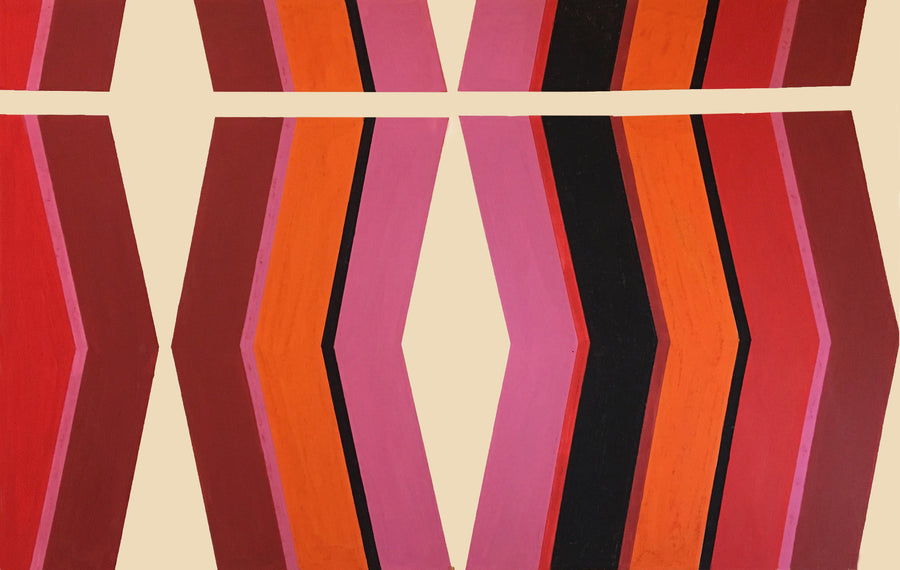
Every print I make starts with someone else's hands. My grandmother Kati painted textiles in her Montreal studio through the late '60s and '70s — bold, saturated, some wild, and some with more child-like whimsy. She never saw most of them made into anything. They sat in the basement of my childhood home for decades after her passing: over 300 original hand-painted designs, just waiting.
I don't remember watching her work. She passed when I was just three. What I do remember is growing up around the results — towels and linens in our house printed with her designs, worn soft and tattered from use. One in particular has stayed with me: a tonal green print of a woman lying in the grass. I loved it.
I was the granddaughter who ended up following in her footsteps artistically, closer than my sisters did. When the archive came to me, it didn't feel like inheritance so much as a job I'd been quietly signed up for without knowing it. I held onto them for over a decade before I even began to seriously consider what to do with them.
Kambric Goods is what I've built around that archive. Every dress, blouse, and print name comes from her paper, not a mood board — though not all the names are hers. Some, like Matyó, come straight from the original designs or their inspiration. Others I've named for the music she would have had on while she painted — the era's soundtrack, folded back into the work.
I trained at FIT, spent my twenties in New York fashion, and eventually landed on the west coast — Fairfax, California now, with my husband and our daughter. But the work is still, at its core, a conversation with someone who isn't here to have it with me anymore. All I can hope is that Kati is proud of the legacy that I am trying to carry forward on her behalf.
This journal is where I'll write about that: the archive, the process, the collections as they come together, and everything in between. Starting here felt right — with her, since nothing at Kambric starts anywhere else.